
Let’s walk through the step-by-step process I use to help my students estimate their quarterly taxes. In this guide, we do our best to estimate what percentage of gross business income you should be saving on all the money earned in order to pay your quarterly taxes. The goal is to help you save and pay them such that when you file during tax season, you won’t owe any additional taxes.
Step 1: Estimate INcome
First we need to figure out your estimated income for the tax year and divide it into buckets. These buckets are different from the tax buckets I mentioned earlier. We’re creating three buckets: net self-employment income, employment income, and other income.
Remember: We are looking forward, not backward. You don’t need to calculate last year’s taxes. That’s what our tax return is for. Instead, we’re estimating what your tax will be on this year’s income or next year’s, or both. Those of use who lack future-telling abilities must instead use the info we have to extrapolate income and expenses.
Estimating income is no exact science, but there are a few ways to get started. You can look at your previous year’s tax return or last month’s income and extrapolate from there. Also consider seasonal differences in income. Do your best to estimate yours and move forward working with what you’ve got.
Every December, I do a detailed breakdown of my net income. This helps me with goal-setting but also informs my quarterly tax savings. Earlier in the book, I shared my streams of income. Here’s an example of how I might set up goals.
I do a push for Unf*ck Your Biz twice per year, once in November or December and once in late spring. Based on past launches, I know I can typically anticipate that about 1 percent of my email list subscribers will join the program.
On average I have one hundred new subscribers per month. Therefore, in December 2021, I expected to grow my list from 6,000 to about 7,200 by the November 2022 launch. I could stop there and estimate 1 percent of 7,200 as my number of potential students/sales, which would be 72. I would add those 72 members to my existing member base to find my monthly recurring revenue.
But we have some more metrics to consider. Business, when done well, is kind of like good gossip: It spreads and grows organically. One person tells two friends about the drama. Those two tell two others, and so on. In business, we get more referrals as we have more clients and customers. We also get on bigger platforms with a bigger reach.
I do my best to project this growth based on the trajectory of my podcast, social channels, and speaking events. I may then anticipate 200 subscribers per month for quarter one and 300 subscribers per month for quarter two.
When projecting your income, consider the natural trajectory of growth you have had and plan for what you expect in the coming year. After all the number-crunching, my list target for my November 2022 launch may be closer to 8,000. With a 1-percent conversion in mind, that’d be 80 students. Now, I can estimate my launch revenue. I repeat this process for each of my programs to project my goal revenue for the program.
If all that sounds too complex, you can always just start with last year’s income and make your best estimate of how much you expect your revenue to change. For example, if I make $200,000 in 2022 and hope for a 20% increase in 2023, that’d be $240,000.
Once you go through this process, you’ll ideally know which number to put in your bucket for self-employment income. The reason we're dividing income into these buckets is due to all that fun FICA and self-employment tax stuff we covered in Chapter 4. If you’re married, include the total of both your and your spouse’s income in each category.
Bucket #1, self-employment income, includes all your income that is subject to self-employment tax. Simple enough, but don’t overlook 1099 income.
Bucket #2 is employment income. This is any income that you or your spouse earns from an employer. More specifically, it’s any income that has already been subjected to tax withholdings.
If you’re a “why” person like me, here’s the reasons for the buckets. Our biz income is any and all income subject to both income taxes and self-employment taxes. The money in bucket #2 you pay income taxes on, and rather than self-employment tax, you and your employer split the taxes for Medicare and social security. The income in bucket #3 is not subject to any taxes with regard to Medicare and social security.
Note: Throughout our tax estimation steps, I use one fact pattern to provide contextual examples.
Example
Barb made $15,000 last year in her first year in business. She had $5,000 in expenses. This year, she expects to double both her income and expenses. She also has a part-time job and expects to make $25,000 there as a W-2 employee. Her wife has a full-time gig as a W-2 employee, where she makes $75,000. Barb’s wife also does freelance work and expects to get a 1099 for $10,000 in income. Lastly, Barb and her wife have a rental property from which they expect to profit $10,000. Barb's buckets would look like this:
Barb’s self-employment income bucket equals her gross income ($30,000) plus her wife's 1099 income ($10,000), less expenses ($10,000), which totals $30,000. The employment income is made up of Barb’s $25,000 and her wife’s $75,000 in employment income, totaling $100,000. Their other income bucket is the $10,000 profit from their rental properly.
STep 2: Find Total and Taxable IncOME
First add up your three buckets to find your total income. Easy peasy. Then, find taxable income. We know from Chapter 4 that to find taxable income we subtract adjustments, the qualified business income deduction, and the standard or itemized deductions. If you’re not sure if you have any adjustments or itemized deductions, deduct your standard deduction to start.
Remember: Fewer deductions means more tax. We’d rather estimate and save on the higher end than fall short on our taxes.
I’m using the 2018 standard deductions for easier math: $12,000 for single taxpayers, $24,000 married, $18,000 head of household.
Example
By totaling Barb’s different income buckets, her total income is $140,000. Barb's standard deduction is $24,000. Her qualified business income deduction is 20% of the net self-employment income of $30,000, which equals $6,000. Barb had no adjustments. Considering those deductions, taxable income becomes $110,000.
STEP 3: CALCULATE INCOME TAX
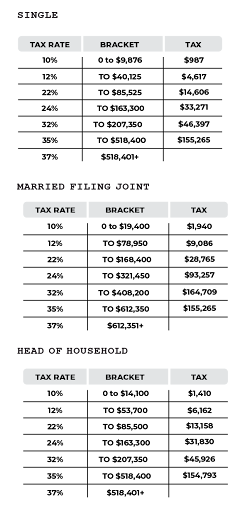
In this step, we calculate the income tax on the taxable income. Make sure to do a search for the tax brackets applicable to the year in which you’re calculating. For our example, we will use these brackets:
Example
We know that Barb’s taxable income is $110,000. She files jointly with her wife. We can see by looking at the bracket that they fall into the 22% bracket. We subtract $78,950 from $110,00 and get $31,050, we then calculate 22% on that chunk of income, which is $6,837. The bracket tells us that the total tax from the first two buckets of income is $9,086. We total $6,837 and $9,086 to get $16,017.
Step 4: Calculate Self-Employment Tax
Next, calculate self-employment tax on each of our three buckets. Remember: It’s 15.3% up to $138,000 and 2.9% thereafter.
EXAMPLE
Luckily, Barb’s income is below that pain-in-the-ass $138,000 threshold. We calculate 15.3% on her self-employment income of $30,000, which is $4,950. Then, we calculate 7.65% on her employment income of $100,000, which is $7,650. The two chunks of tax total $12,240.
Step 5: TOTAL TAXES
This is our simplest step. Yay! Add your total from steps 3 and 4.
Example
Barb’s taxes were $16,017 and $12,240. That totals $28,257.
Step 6: subtract credits
I have learned through working with my students that there’s one big credit I shouldn’t overlook: the child tax credit. My husband and I are childless, so this credit often slips past me.
Recently I had two students with income relatively similar to Barb’s. However, one student has two children. The other does not have kids. With the child tax credit, the one student’s tax was actually about $4,000 less. Considering that led to 4% less she needed to be saving for quarterly taxes, that’s a pretty substantial amount.
So if you have children, focus on this credit.
You can qualify for the child tax credit if your income is less than $400,000 married filing joint, or $200,000 otherwise. Note that these limits are subject to change. Taxpayers get a $2,000 credit per child. If you have 10 kids, you get $20,000 in child tax credits (and also hopefully a lot of help from family and friends). Please also note that only part of this credit is non-refundable. There are also specific requirements you must meet to claim the child tax credit. If you’re interested in learning more about that and other limitations, do a quick search.
I bring up the child tax credit because it’s relatively easy to calculate and is a pretty substantial benefit. There’s also a credit called the child and dependent care credit when you pay for child care. There’s also the earned income credit, which is available to lower-income individuals who work. Those tend to be the big three, but there are several other, less-common credits.
If you want to have a super accurate quarterly tax calculation, feel free to look into these more. I err on the side of simplification because I know you don’t want to read a treatise on tax, and also because it’s better to underestimate tax benefits and overestimate tax.
Example
Let’s assume that Barb and her wife also have one kid. They get a $2,000 child tax credit, which is a dollar-for-dollar reduction in tax. Now, their total tax is $26,257.
STEP 7: FIND FEDERAL TAX PERCENTAGE
Now, we find the effective tax rate for federal taxes. To do that, take a step back and find gross income. Remember: Gross income is income before any expenses. So take the total income and add back in any expenses that had been deducted. From there, divide the total federal tax due by the gross income.
Example
Barb’s total income was $140,000. We add back in Barb’s expenses of $10,000 to get gross income of $150,000. Then, we divide her tax of $26,257 by $150,000 to find the effective tax rate of 17.5%.
In other words, roughly 17.5% of every dollar Barb and her wife bring into the house is turned over to the IRS for federal tax. Now, we need to lump in state taxes.
Step 8: CALCULATE SALES TAX PERCENTAGE
We talked about state taxes in Chapter 4. Revisit that material if you need a refresher. Here we’re using our shortcut if applicable. Since we already calculated the federal percentage, you can figure the state percentage as one-fourth or one-fifth of that.
Alternatively, if you’re in a flat tax state, the process is a bit different. You have to calculate the tax first and then figure the effective tax rate. Here’s a quick example: Albert has taxable income of $15,000 and gross income of $40,000. If he lives in a state with a flat tax of 5%, his tax would be 5% of $15,000 or $750. The effective state tax rate is $750 divided by gross income of $40,000, which rounds up to 2%.
Lastly, if you’re in a state with no income tax, write down a big fat 0.
Example
We will assume that Barb is a resident of California, which is a high tax state. Thus, we calculate her state tax as one-fourth of her federal tax percentage of 17.5%. Quick calculator math and rounding tell us that her state tax percentage is about 4.5%.
STEP 9: FIND TOTAL TAX PERCENTAGE
We saved maybe our simplest step for last. Add your state percentage to your federal percentage.
Example
Barb’s state percentage is 4.5% and her federal percentage is 17.5%, which totals 22%. We will call this her quarterly tax percentage.
Now add your totals. Put this total on a sticky note, and use it as your bookmark. We want to cement it into your noggin’. In further chapters, I ask you to recall your quarterly tax percentage.
SUMMARY
Remember: This total percentage is how much of your gross business income you should be setting aside for taxes. Also, mentally note that your percentage may change as your total income increases or decreases. For example, if you were to cash out a trust or IRA, or you were to win some money or otherwise acquire more income (other than by gift), your income would increase. Not only do you need to pay tax on that income, but you need to consider that it will also increase your tax bracket, so you need to set aside more of your business income for quarterlies.
RECENT BLOGS