
How much money is your business actually making you? The first step to knowing how much you're bringing home in profit from your business, is learning how to actually find business profit. This is also the first step in calculating what you personally owe in taxes each year.
SCHEDULES AND TAX FORMS
Imagine a tax return as a giant binder full of forms. We’re talking about a thousand pages. Each form has a number or letter (Form 1040, Schedule C, Schedule E, and so on). The first form is the 1040. The Form 1040 is like the cover page. It’s a snapshot of your tax return. It asks for your name, address, social security number, and spouse’s and children’s information.
In the bottom section of the 1040 form, it asks for your W-2 income, business income, and other areas of income and “adjustments.” If we assume you have simplistic taxes (for example, say you get a W-2 and have no other income nor wish to take any other tax benefits), you could actually just fill out Form 1040, sign it, attach your W-2, and mail it off to the IRS. That would be your completed tax return.
However, most of us need more forms. If you have a child, you’ll claim a child tax credit on line 18b of the 1040. That will direct you to the Schedule 8812, so you’d flip to that schedule in our hypothetical binder and fill it out. If you’re a student, you want to claim the American opportunity credit on line 18c of the 1040. That line directs you to flip to Form 8863, so you find that and fill it out.
If you’re reading this, you likely have self-employment income. As you scan through the 1040, you’ll notice line 7a asks for “other income.” To calculate other income, you must fill out and attach a Schedule 1. You flip to the Schedule 1. It has a whole host of lines as well. Line 3 asks for your business income, but to find business income, you must flip to the Schedule C. (I explain this form in more detail shortly.)
Your tax returns are like Matryoshka stacking dolls straight out of a Russian market: For some of us it's like an inception of 100 forms; for others there are just a few. Can you tell I was a Russian language and political science major in college?
For all of us solo, non-corporate business owners, the Schedule C is one of those forms that's like the stacking dolls. You fill out the Schedule C, find your business income, and plug that into line 3 of the Schedule 1. You finish the Schedule 1 to find your “other income.” You take that total and plop it back onto line 7a of the 1040.
You can imagine the number of forms you’d be flipping to in the binder if you owned multiple businesses, rental properties, and investments, and claimed other, more unique tax benefits.
When you use a program like TurboTax, it asks you questions and lays out the process in a more digestible way. The software transposes that information onto the proper tax forms. You provide an electronic signature, and it bundles up your own unique binder of tax forms—the relevant ones—and submits it to the IRS for you.
When you hire a tax pro, it’s a similar process. They’ll likely use more sophisticated programs and bill you by form. The more complicated your taxes, the more information they must gather, and the more forms they must complete. It’s like those ladies in Siberia: The more stacking dolls in the set, the more they charge. More labor equals more cost.
Now imagine you file your own tax return. You get a call from the IRS and the agent says you’re a fifty-stacking-doll kind of taxpayer, but they only got forty-nine forms. Or you might get a letter that says something like “Blah, blah, blah, bloppity blah. . . . Please complete IRS Form 8962 and fax it to 555-UGH-TAXES.
That’s scary. Are you getting audited? Did you fuck it up? What’s going on? In this case, what most likely happened is, if you self-filed, you forgot to check a box, maybe you answered a question wrong, or maybe there was an issue with the tax software (less likely) and the program, therefore, did not complete a certain form. Form 8862 deals with health insurance when you have a plan through one of the exchanges. If, for example, you stated on your return that you have private insurance through an employer, you wouldn’t be prompted to fill out that form. The software wouldn’t include it in your binder, and the IRS may come knocking to get it.
What do you do? Google the form, fill it out, and mail it to the IRS. If you get stuck, there’s probably a YouTube video that can help. You may or may not owe a difference on the tax. If you do, you send in the payment. Boom—you’re done, hopefully.
Two Types of IRS Forms
I mentally separate IRS forms into two categories. First are the informational request forms (the W-9s and W-4). The purpose of those is to collect information needed for the second type of form: the informational forms you get to help file your taxes (the 1099s, W-2s, K-1s, and the like). These forms are completed by a third party and issued to you, and you report that info on your tax return.
For example, a 1099 reports payments that are not wages. If a web design company hires a graphic designer to do contract work throughout the year, that company will take a tax deduction for the amount paid to the designer.
The IRS wants to verify that a reduction in income by one person correlates to an increase in income for another person. The IRS does this with 1099s. If a company files a 1099 for you, but the IRS does not receive a tax return matching that 1099’s info, the IRS now has an inconsistency that can trigger an audit, letter, request, or phone call, to collect taxes on that unreported income.
K-1s and W-2s serve the same purpose. These are our “informational forms.”
The second type of tax forms are those that are part of the tax return. These are forms like the Schedule C.
Schedule C
The Schedule C is the form you (or your tax software) fills out to report your business income if you are a sole proprietor or a single-member LLC. If some smarty-pants asks if you file a Schedule C, they’re effectively asking if you are a sole prop or a single-member LLC.
We will talk more about what a sole prop actually is in Part 2 and Part 5, but here’s the gist: If you don’t have a business partner, and you haven’t formed a “formal entity” like an LLC or a corporation, you’ll be a Schedule C filer. Before continuing, take a second to Google “IRS Form Schedule C.” Open it and give a quick skim.
You’ll see that it asks for your business name, employer ID number (EIN), accounting method, income, costs of goods, and various expenses. If you’re ever confused about how your business profit is calculated or what may or may not be deductible, it’s always a good idea to start with the forms to get some insight.
The lines in the expense section of the Schedule C show common categories and what’s allowed. Every IRS form also has a set of form instructions. These instructions tell you how to fill out various lines on the forms. Look at line 23 of the Schedule C, for example. You’ll find this is where you report deductions for taxes and licenses. But maybe you don’t know what the IRS considers to be a deductible. You can Google the IRS Schedule C Instructions and go to the section on line 23. It will tell you:
“You can deduct the following taxes and licenses on this line.
State and local sales taxes imposed on you as the seller of goods or services. If you collected this tax from the buyer, you also must include the amount collected in gross receipts or sales on line 1. . . .”
That part of the instructions lists several other taxes, but also goes on to state what you cannot deduct, including federal income taxes.
1065s AND 1120s
Partnerships, S corps, and C corps actually file business returns. We will talk more about the distinction between these later, but for now, just know that they use different forms.
S corps file an 1120s and partnerships use Form 1065.
FREE RESOURCES
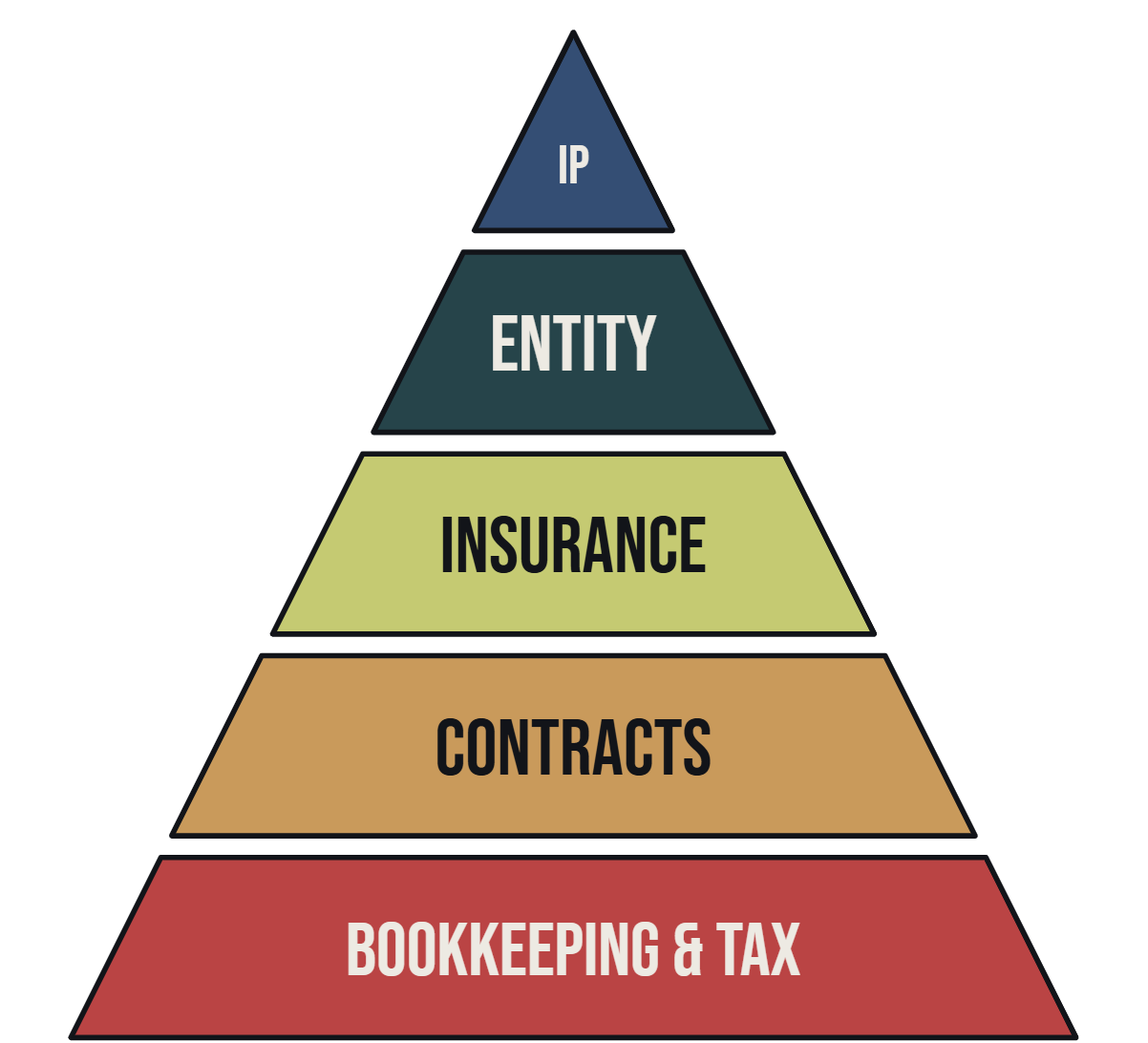
Protect your business with the five layers of legal protection. Learn more about them and get free resources to help you.
SELF-EMPLOYMENT INCOME
When I was a baby, I remember playing the “I’m going on a trip” game. Do you remember that one? I’d say, “I’m going on a trip, and I’m taking a Skip It.” The next person would say your thing plus one more. “I’m going on a trip, and I’m taking a Skip It, and my autographed copy of the latest Backstreet Boys single on cassette.” The third person adds her peak ’90s inflatable furniture to the list. A few more rounds in, and you’ve added a Tamagotchi, Scary Stories to Tell in the Dark, and a notebook with all your friends’ phone numbers, which you’ll need when using your prepaid minutes phone card to share your thoughts on the latest Boy Meets World plot twist.
In this game, you’re “out” when you forget any item in the order. When you play, you find that you can remember quite a bit when repeated in a repetitive manner. If your friend spouted out a list of ten things, and you had to repeat it back, you’d be hard pressed to remember. I use this tedious memory device to teach taxes. We start with the first step and methodically move forward.
Taxes are calculated by taking all of our income, adding it up, subtracting from that total certain deductions, and calculating the tax on the balance. Our starting point is understanding what the IRS considers to be taxable income, and we narrow in even further to self-employment income. This is the first item we’re taking on our trip.
The IRS defines self-employment income as “income earned from carrying on a ‘trade or business’ as a sole proprietor, an independent contractor, or some form of partnership.”
For most purposes, business and self-employment income are the same. Notice that the IRS’s definition above does not include income to S corps or C corps. The income may not technically be from self-employment. (This will make more sense in a bit.)
I’d like you to consider my personal, simplified definition: Self-employment business income is any money earned in exchange for something else of value outside of an employment context.
My former income tax law professor could find some faults in that definition, but it will work for us. We distinguish self-employment income from all other types of income because it’s taxed in its own unique ways. Note that in my definition I use the phrase in exchange for something else of value. This is because bartering is also considered a taxable event.
For example, I hired an editor to help me with this book. If she had said, “You know, I really need some help for my business. Can you add me as a student to Unf*ck Your Biz as a trade for my editing services?” If I said yes, the value of her editing services would technically be taxable income to me. It’s a form of compensation I’d be receiving in exchange for providing a product or service in return.
Let’s look at some more common examples of self-employment income.
Elle is a law student. She decides to start a weekend gig tutoring undergrads on the LSAT.
Tamika works full-time in marketing. She loves design. She agrees to provide interior design services to two co-workers who are moving.
Elle and Tamika both have self-employment income. Tamika might argue that she doesn’t really have a business, and thus the money from her co-workers isn’t really self-employment income. In that case, she’d look more into what the IRS considers to be a “trade or business.” We won’t go down that rabbit hole because I’m making a big assumption here—which is, if you’re taking the time to read this book, you, at a minimum, intend to have a profitable business.
That intent is enough to make your income self-employment income. We’re not hobbyists here. We are very serious capitalists and entrepreneurs seeking profits. But if you want to use those profits to defeat the patriarchy and further world peace, I support you.
RECENT BLOGS