
We do bookkeeping for two reasons.
First, properly accounting for income and expenses in the correct accounts helps us file our taxes more easily. If we match our accounts to the categories on the tax forms, it's as easy as taking the total for that account and reporting it to the same category on the tax return. Also, if you get audited, you have to prove, or “substantiate,” your deductions. Bookkeeping is one way to do that. More on this substantiation BS later.
Second, our bookkeeping gives us key financial insights. Without solid data points, you may as well consult a Magic Eight Ball when making decisions. Our profit and loss statement (P&L for short) is where we gather this financial information.
THE PROFIT & LOSS
A profit and loss statement (P&L) is created by and for your company. It’s typically not submitted anywhere. The P&L shows a snapshot of income, expenses, and profit. Let’s take a look.
Our total business income is our top line on the P&L. I typically just call it revenue.
Next, we have cost of goods. Cost of goods is a business expense that is part of the end product. My friend Lauren runs a successful Etsy shop for which she creates wreaths for various holidays. All the craft stuff she buys to go into the wreaths are costs of goods. However, the scissors she needs are not a cost of goods. They don’t become part of the end product. The scissors are a supply.
Perhaps a simpler example would be a bakery. Picture a cupcake. All the ingredients that go into the cupcake are costs of goods. If I’m eating it, it was a cost of goods to the baker.
The majority of service providers will not have costs of goods but for small exceptions. On my website, I sell a physical copy of this book. The book costs roughly $12 to print. That is my cost of goods. The book sales are a small portion of my revenue pie (less than 2% of my total revenue), but I still must track my cost of goods.
Gross profit is revenue minus cost of goods sold. Gross profit is an essential number to stay on top of if you’re in a primarily product based business. However, if you have $0 in cost of goods, your gross profit is the same as your revenue.
Next on the P&L come the expenses. Expenses are most of the things we can deduct other than the cost of goods. There are a few expenses we don’t include on the P&L because they are part-personal/part-business expenses. I call these hybrid expenses. Generally, these include your cell phone, internet, other utilities, rent, and home expenses if you have a home office, and use of your car. We should pay for these from our personal bank account and account for them separately from what I call our fully deductible business expenses.
Gross profit minus these fully deductible expenses equals our profit, also called net income. We could stop there, but I add a couple extra lines. Take a look.
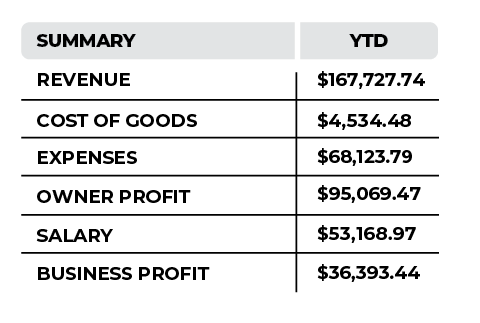
In an S Corp, owners put themselves on payroll and get a check just like they would if they were an employee of any other company. Those checks, the owner’s salary, are a business deduction. The owner gets a W-2 to report the income, and the business deducts the payments as an expense. Don’t you worry: I explain this in detail later. For now, try to focus on why this irritates me from a consistency perspective.
I might talk to three business owners who each have revenue of $100,000 and expenses of $30,000, aside from the owner’s salary. Business owners B and C each take a $50,000 salary through payroll.
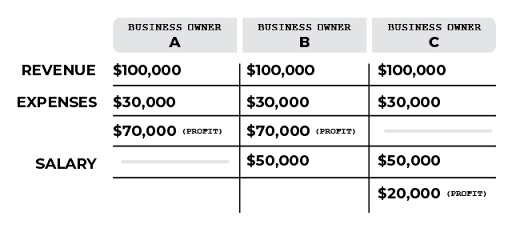
Business owner A says their profit is $70,000, which is the revenue minus the expenses.
Business owner B says their profit is $70,000, which is the revenue minus the expenses even though they took a $50,000 salary.
Business owner C says their profit is $20,000, which is the revenue minus the expenses and salary.
Can you see how all three have essentially the same profitability with $100K revenue and $30K expenses? Business owners B and C are actually identical, but they’re calling profit two different things.
My extra lines are the P&L are designed to give us uniform language and fix this issue. We don’t include the owner’s salary with the rest of our expenses. And note that when I say “salary,” I always mean salary run through payroll subject to tax withholdings. If you are simply transferring money from one bank to another on your own, that’s not salary. I’ll call that type of payment owner payments or distributions.
The “owner’s profit” is the profit before deducting salary. We then have the owner’s salary expense. Owner’s profit minus owner’s salary is business profit. If you don’t run payroll, your owner profit and business profit would be the same because salary would be $0.
Here’s the breakdown using my method:
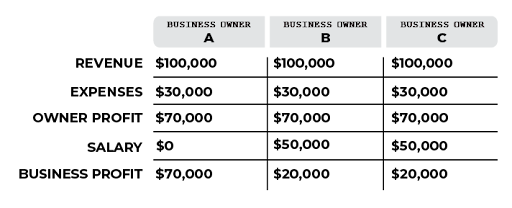
Using the example above, we could say that business owners A, B, and C each have owner’s profit of $70,000. Business owner A also has business profit of $70,000 because he doesn’t take a salary. Business owners B and C each have business profit of $30,000. We need to know these different profit numbers for tax purposes, but we can see by the owner’s profit that each business is essentially in the same financial position.
Here’s a simple example of why knowing these numbers are useful. If you apply for a car loan, the lender needs to know your income. If you don’t get a W-2, you show your profit from a tax return. That’s all they need. But, you should know your take-home pay as well as your monthly expenses. Your owner profit gives you a better indicator of what you can actually afford.
This distinction should make even more sense later when we discuss how owner profit and business profit is taxed in different business structures. If you are not on payroll, I’ll also share how you can treat your owner’s payments like owner’s salary to structure your P&L similarly to someone who is on payroll.
Four Types of ACcounts
There are four types of accounts you see in Quickbooks and similar programs: income accounts, expense accounts, cost of goods, and equity accounts.
The first two are pretty simple. One way is to break down income accounts. All items of income go into income accounts and all deductible business expenses go into expense accounts. Remember that our expense accounts can largely mirror our tax forms with some tweaks. Cost of goods goes into the cost of goods accounts. We intuitively understand this, but we still must be careful.
When I created my chart of accounts in Quickbooks, I added an income account for “Book Sales.” This books cost about $12 per copy to print. That’s my cost of goods. I also named that account “Book Sales.” Not my smartest idea. I have two accounts with the same name, but one is an income account and one is a cost of goods account.
It should still be easy for me to spot $30 in income from a book sale and classify it to the Books Sales income account, while putting the $11 charge to the Book Sales cost of goods account.
Equity accounts are those that help us see how much ownership stake we have in the business. These are the ones that trip everyone up. Whenever you contribute money to the business or withdraw and transfer money out of the business, you have an equity transaction. If you do your books on a spreadsheet, don’t sweat this one.
RECENT BLOGS